UPDATE: 05/08/20
The big DOB now has a Sky Commander computer installed. That wouldn't be an accomplishment to
crow about except that I had to fabricate all the mounting hardware myself. The mounting kits were out of stock. They didn't know when they would get more in, and they didn't know if they would be operational
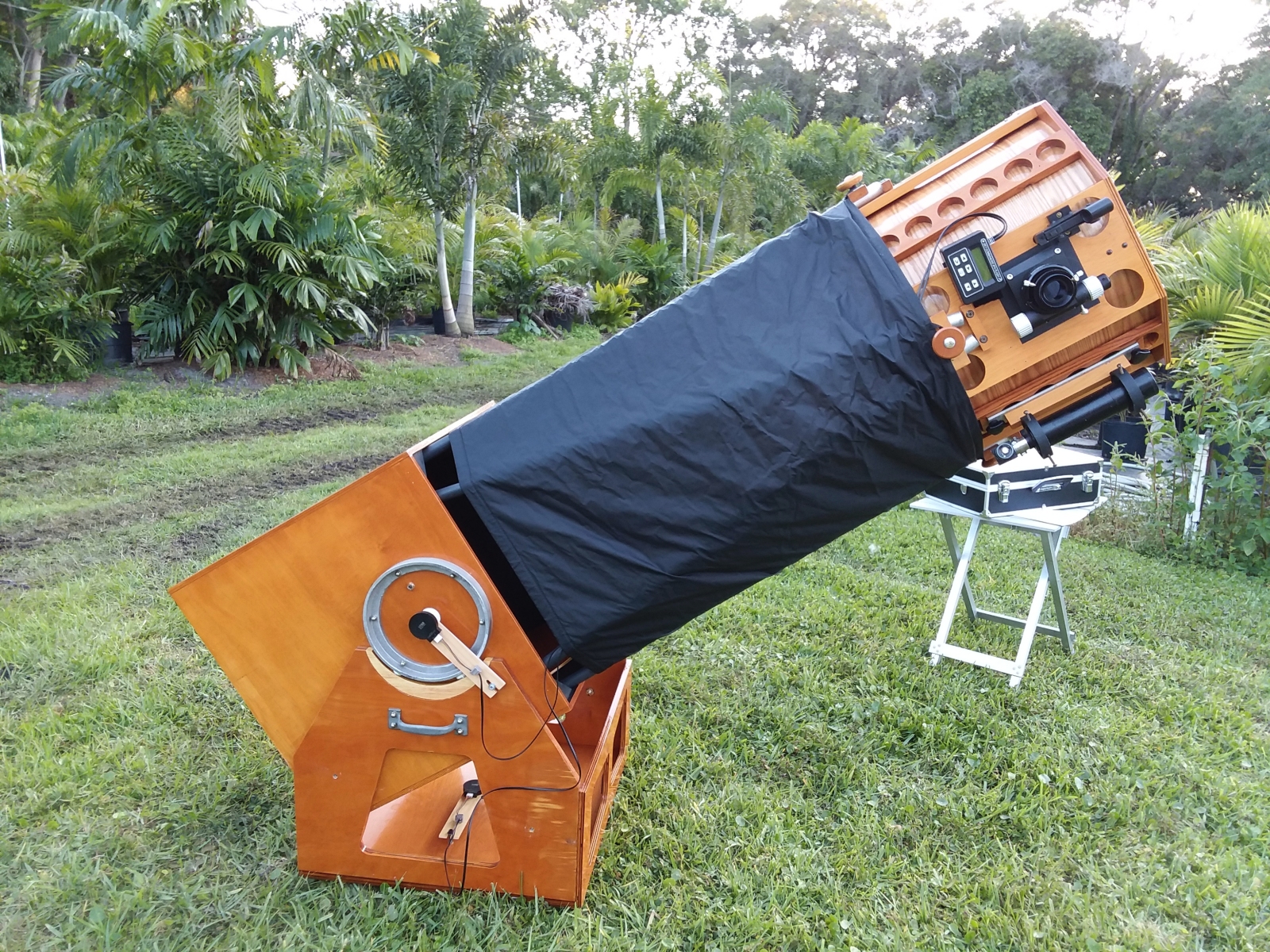
to ship them given the Corona Virus lockdown. So rather than wait, I fabricated my own hardware. This photo shows the completed installation. It only took a couple of days, and I saved a little
money. Plus I had to raise the OTA by making wood crescents to go in the original cutouts in the rocker box. The scope wasn't originally designed with having an encoder on the azimuth axis in mind. I needed
to raise it by about 1.5 inches to make room for the corner of the mirror box to clear the azimuth encoder.
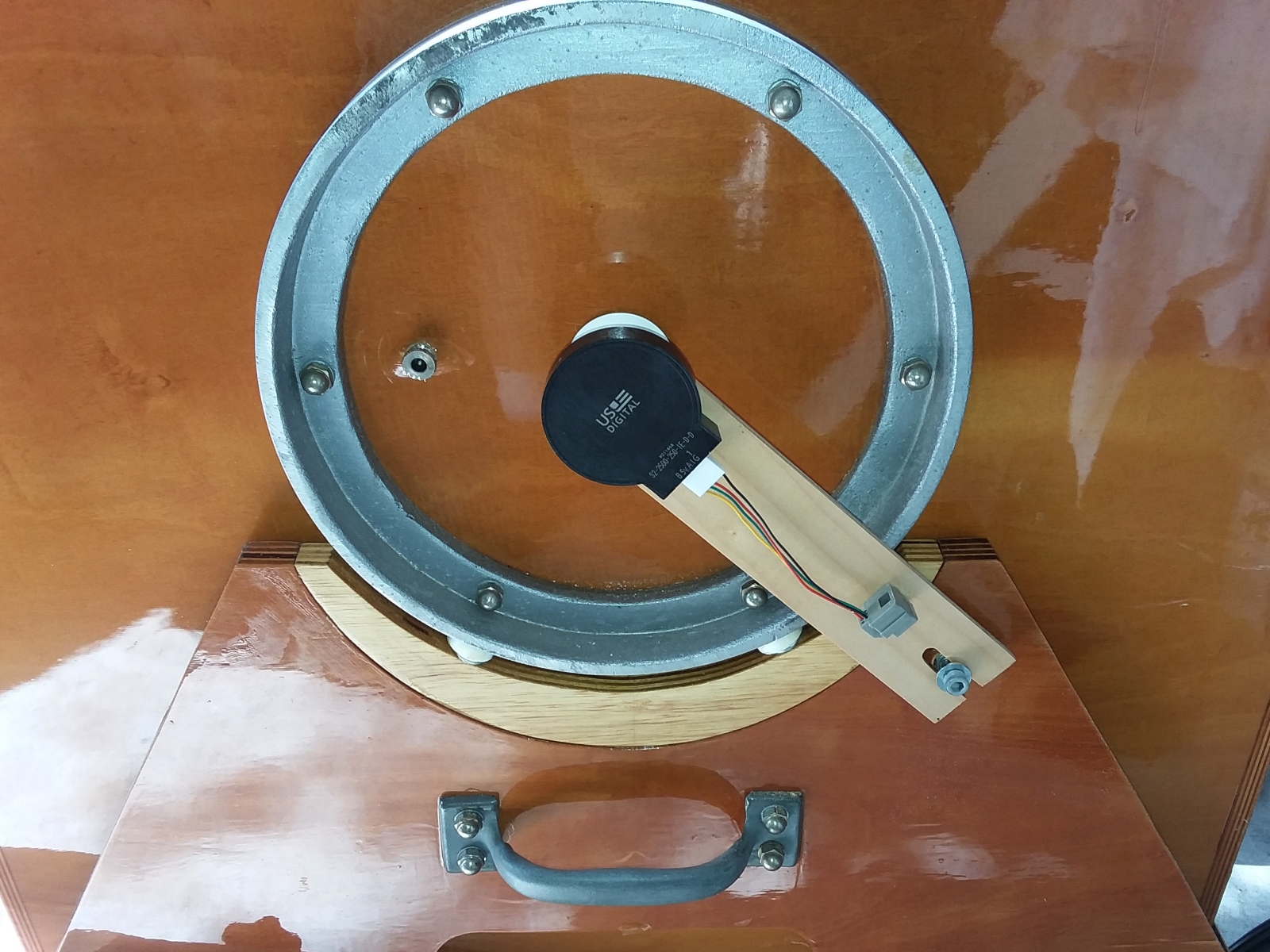
Here is a close up of the encoder installation on the altitude axis. It works! My home-rolled mounting hardware worked perfectly. I was able to locate several deep sky objects I likely not been able to locate
through the light pollution here at home without the Sky Commander. I can't wait to get it out under a dark sky and try it out. I hear that the park we use for our dark sky observing site may be reopening
soon.
UPDATE: 06/17/16
Two pieces of big news about this scope. First, almost exactly 20 years after I originally built it for the St. Petersburg Astronomy Club, the Board of Directors has voted to give the scope to me, in appreciation
for storing it and hauling it out to public events all these years. So the scope I built so long ago is mine now. Thanks, guys.
Now that I own it, I have plans for some changes to it. It is now much easier for me to make needed changes and modernizations without having to go through the Board for approval and funds. The first
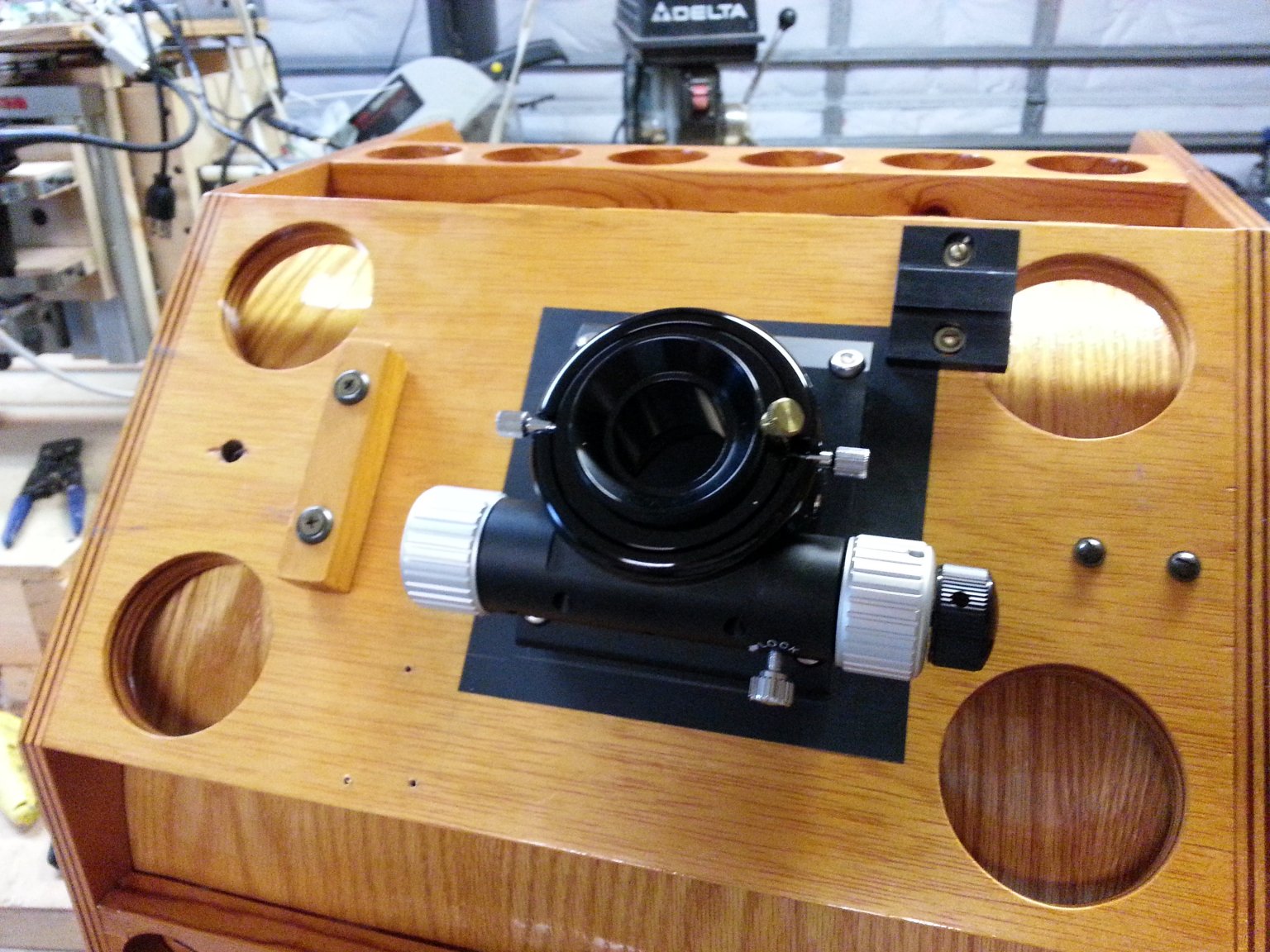
new change has already been implemented. I have replaced the original, old, 1st gen, 2 in. Crayford focuser that has been on this scope since day one with a new, Orion, low-profile, dual speed focuser. This
photo shows the new focuser in place on the secondary cage. The old focuser was just plain wore out, and was totally inadequate for photography.
Future plans include shortening the truss rods slightly to bring the focal plane out far enough for planetary photography, procuring a new light shroud and cover for the scope, and the fabrication of a
combination focus mask and aperture stop for the front of the scope to help facilitate photography. Long range plans may include an eventual complete redesign and rebuild of the scope to make it lighter
and more compact. I am not as young as I was 20 years ago when I first built this thing. Hauling it around gets more difficult with each passing year. I would like to lighten it up so I can continue using
it well into my old age. An idea I have kicked around is permanently installing it in an Observatory on my remote Arizona property. Don't know about that yet. Maybe when I am closer to retirement.
A video of the 17.5 inch DOB being set up at the 2010 Orange Blossom Star Party. It takes less than 10 minutes to set up.
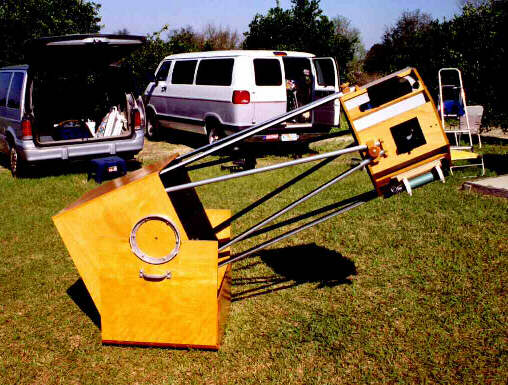
In 1995 The St. Petersburg Astronomy Club acquired a 17.5in mirror. The board of directors of the club
asked me to build a scope around it in time for their annual star party in early 1996. This is
the result.
The scope was built in only 3 months. In spite of the fact that it was a rush job, it turned out very
well, and has survived 5 years of very hard use including long road trips to Texas and Arizona. It is
used several times a month at the many public events held by the club.
The scope was designed to be as portable as possible for such a large instrument. Here it is broken
down and ready to go up a ramp into a minivan. The secondary cage nestles into the rocker box. The
truss tubes are in the long black bag. The toolbox holds the Telrad, 60mm finder scope, and a few
other bits. No tools are necessary for setup or breakdown.
Photos of the construction of the 17.5 inch Dob
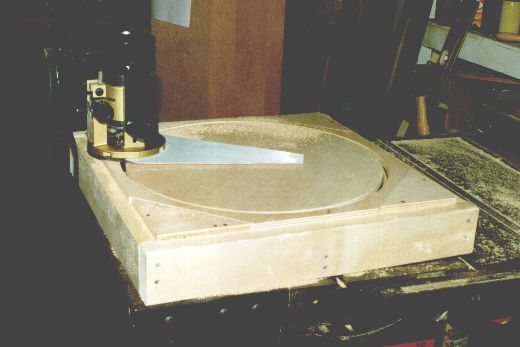
This photo shows the process of cutting the large circular opening in the plywood octagons that make
up either end of the secondary cage. This is done with a plunge router with a homebuilt circle
cutting jig attached.
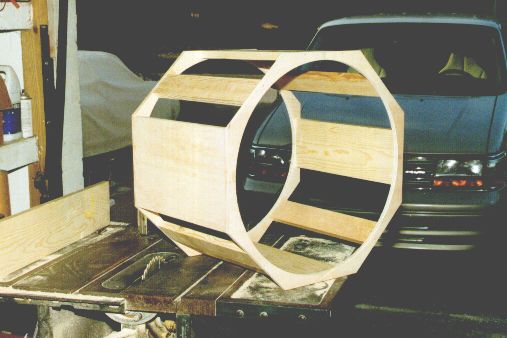
Here is a photo of the secondary cage sitting on my table saw shortly after assembly and before
finishing. The two octagons are the only moderately difficult pieces to make. Everything else is
just straight cuts.
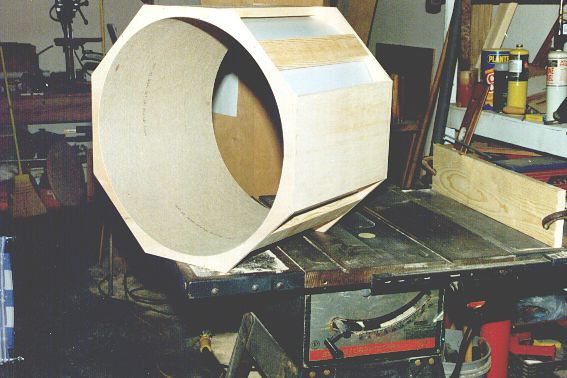
Here the secondary cage has had a sheet of Formica cut to size and installed inside as a light-weight
light baffle. The inner surface was painted black during finishing.
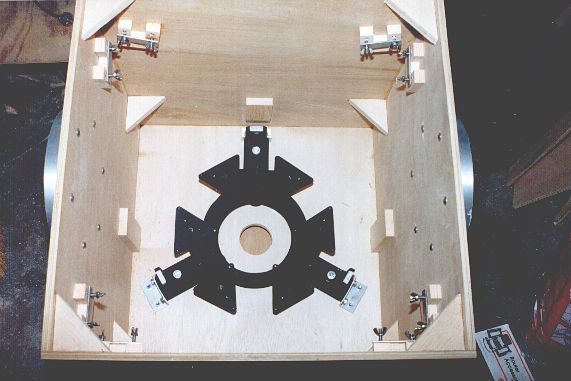
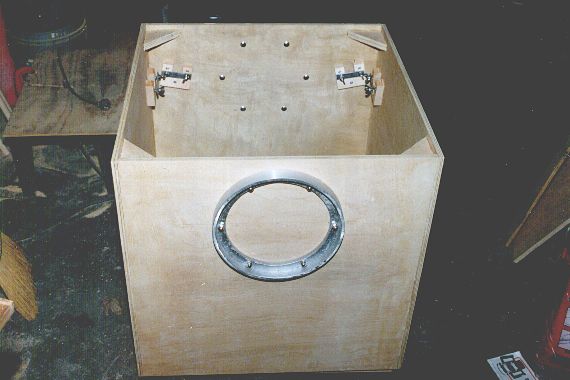
This is a look inside the completed mirror box before finishing. At the bottom is the 18 point Kenneth
Novak & Co primary mirror cell. The 8 "U" clamps for the trusses are also visible.
This outside view of the mirror box shows one of the Kenneth Novak & Co altitude bearing rings
mounted on the side of the box. On the inside you can see the six mounting bolts for ring on the other
side, as well as another view of some of the "U" clamps.
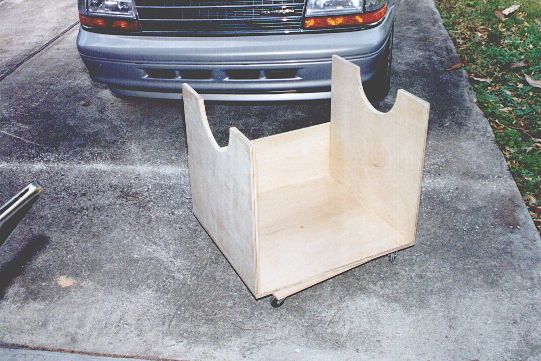
Here is the completed rocker box before finishing and adding bearing hardware.
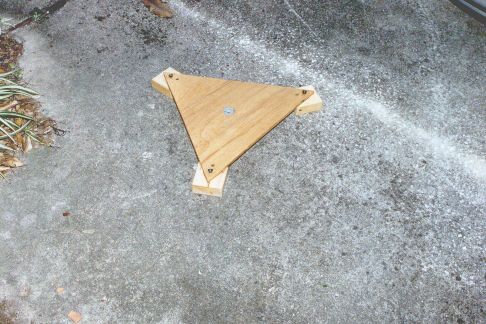
Here is the ground board that the rocker box sits on and pivots around.
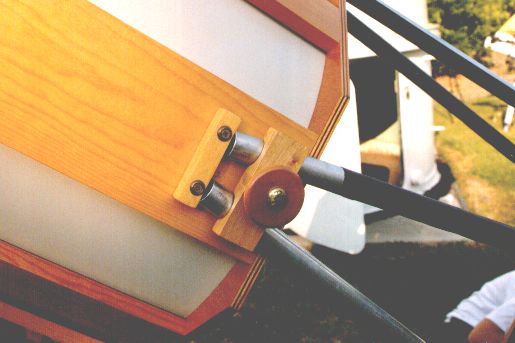
Here is a detailed shot of one of the upper truss clamps.
UPDATE!
After nearly 10 years of hard use, the scope was in bad shape. Wear and tear of setting up and tearing down and nightly drenchings with dew had
taken a heavy toll on the scope. It badly needed refinishing. Since I was working on the scope anyway, I took the opportunity to remodel it. I
wanted to lighten it up a little and make it a bit more modern looking, as well as refinishing it and making it beautiful again. The photos below
show the scope after its remodelling job.
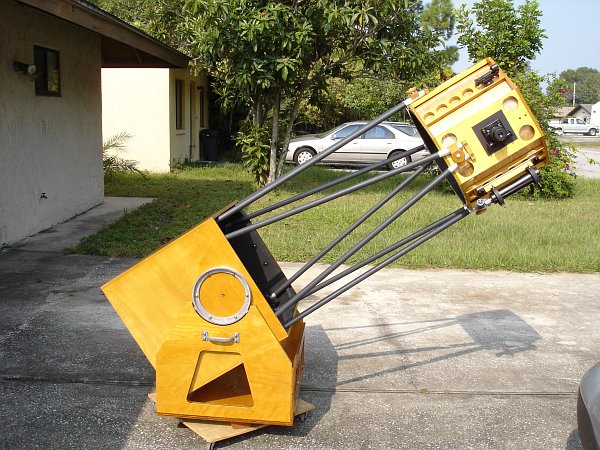
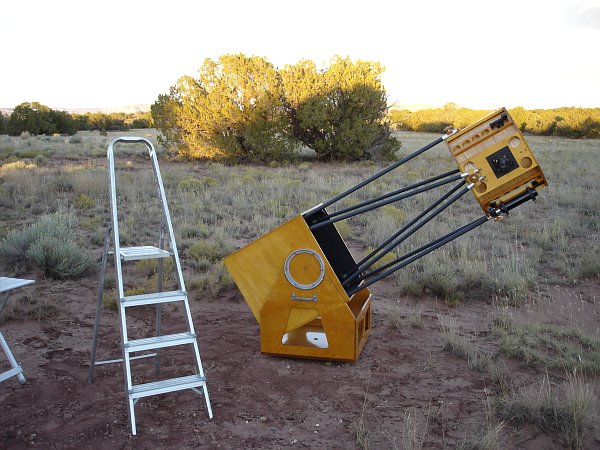
Here is the new and improved 17.5 inch Dobsonian Scope. It got a complete remodeling and refinishing. It now looks brand new again and
a little more modern I think.
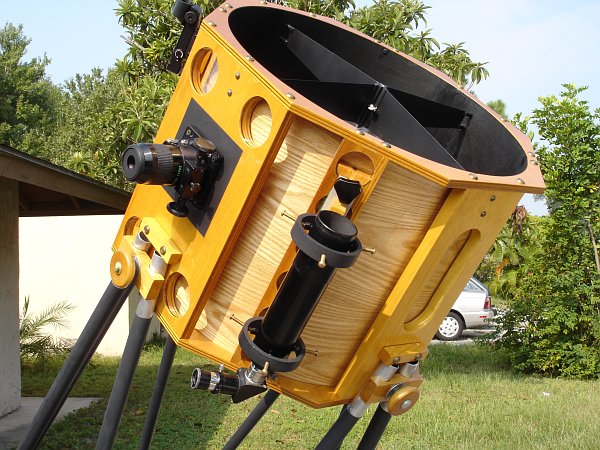
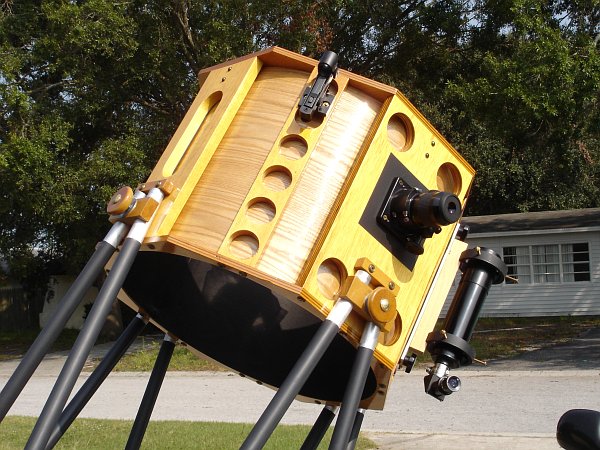
Here is a closeup of the remodeled secondary cage. I made a lot of changes up here. Probably the most obvious change is all the holes
I cut in the wood to lighten it. Lightening the scope was one of the main goals of this remodeling. For every few ounces shaved off the
secondary cage meant I could take pounds off the main mirror box.
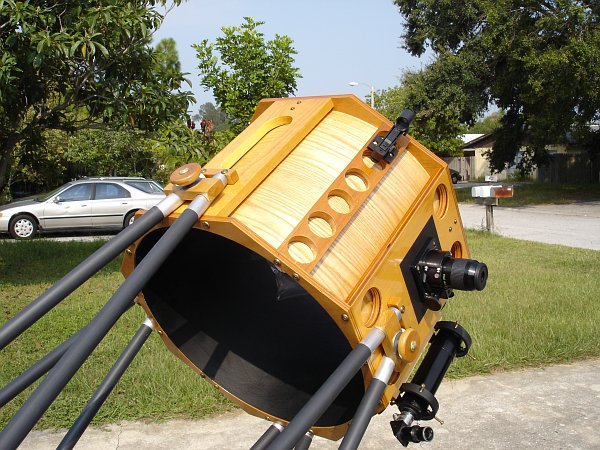
Here is another view of the secondary cage. Aside from the Swiss-cheesing of the wood to save weight, I also replaced the original Formica
light baffle with a sheet of very thin and light oak wood veneer. I also ditched the Telrad I had been using and replaced it with a tiny red-dot
sight. It's not as easy to use as the Telrad, but it is a lot lighter.
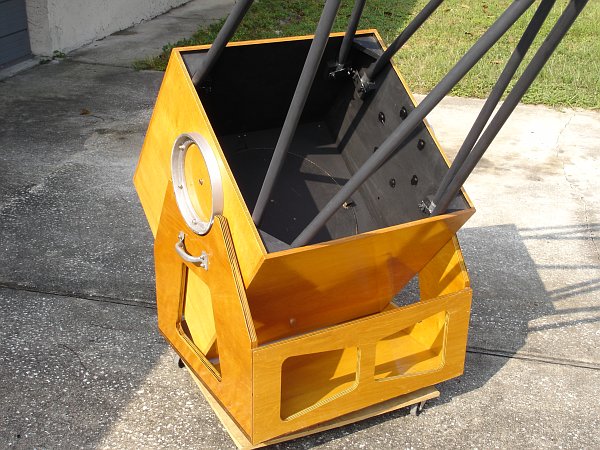
On the rocker box I cut off unnecessary corners and cut holes in the structure to lighten it. All together the modifications shaved over 25
pounds off the weight of the telescope. It's still a very heavy scope, but every little bit of weight savings helps my back.
Another modification I made was to cover the Aluminum trusses with black heat-shrink tubing to darken them. It's a lot better looking than
the black duct tape I had been using before. I also refinished the small refractor finder scope. I think the scope really looks great, but I
may be a little biased.
As the first big outing for the newly remodeled scope, I took it out to my property in rural Arizona. I spent a week out there observing under
the pristine Arizona sky. It was a great time and the scope worked like a champ.
Here is a photo of the big Dob set up at the Orange Blossom Special Star Party in February 2006 at the Alafia State Park.
As you can see, it is decked out with all its accessories, including its matching wooden finder scope
and its heavy-duty equatorial platform.
Another photo of the big scope at the OBS Star Party. It got a lot of use during the four nights I was there.
 In 1995 The St. Petersburg Astronomy Club acquired a 17.5in mirror. The board of directors of the club
asked me to build a scope around it in time for their annual star party in early 1996. This is
the result.
In 1995 The St. Petersburg Astronomy Club acquired a 17.5in mirror. The board of directors of the club
asked me to build a scope around it in time for their annual star party in early 1996. This is
the result. 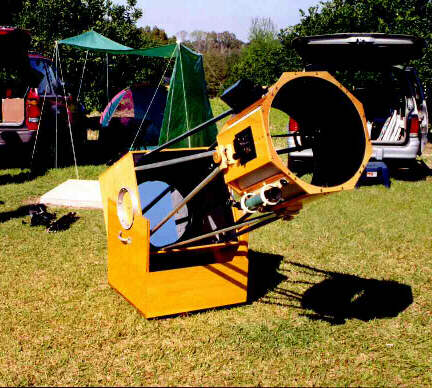 The scope was built in only 3 months. In spite of the fact that it was a rush job, it turned out very
well, and has survived 5 years of very hard use including long road trips to Texas and Arizona. It is
used several times a month at the many public events held by the club.
The scope was built in only 3 months. In spite of the fact that it was a rush job, it turned out very
well, and has survived 5 years of very hard use including long road trips to Texas and Arizona. It is
used several times a month at the many public events held by the club.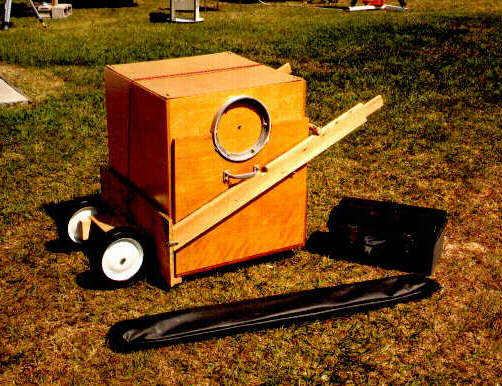 The scope was designed to be as portable as possible for such a large instrument. Here it is broken
down and ready to go up a ramp into a minivan. The secondary cage nestles into the rocker box. The
truss tubes are in the long black bag. The toolbox holds the Telrad, 60mm finder scope, and a few
other bits. No tools are necessary for setup or breakdown.
The scope was designed to be as portable as possible for such a large instrument. Here it is broken
down and ready to go up a ramp into a minivan. The secondary cage nestles into the rocker box. The
truss tubes are in the long black bag. The toolbox holds the Telrad, 60mm finder scope, and a few
other bits. No tools are necessary for setup or breakdown.